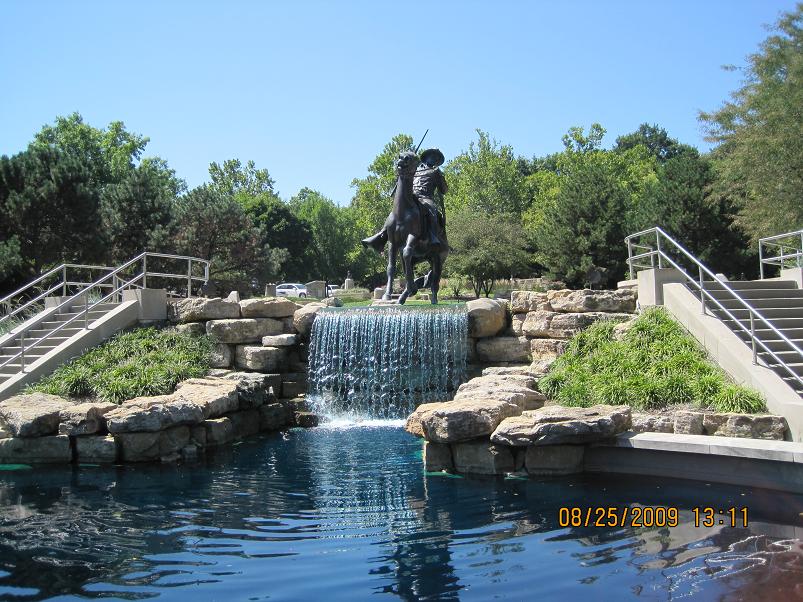
Buffalo Soldiers originally were members of the U.S. 10th Cavalry Regiment of the United States Army, formed on September 21, 1866 at Fort Leavenworth, Kansas.
The nickname was given to the "Negro Cavalry" by the Native American tribes they fought; the term eventually became synonymous with all of the African-American regiments formed in 1866:
* 9th Cavalry Regiment
* 10th Cavalry Regiment
* 24th Infantry Regiment
* 25th Infantry Regiment
Although several African-American regiments were raised during the Civil War to fight alongside the Union Army (including the 54th Massachusetts Volunteer Infantry and the many United States Colored Troops Regiments), the "Buffalo Soldiers" were established by Congress as the first peacetime all-black regiments in the regular U.S. Army.On September 6, 2005, Mark Matthews, who was the oldest living Buffalo Soldier, died at the age of 111. He was buried at Arlington National Cemetery.
Sources disagree on how the nickname "Buffalo Soldiers" began. According to the Buffalo Soldiers National Museum, the name originated with the Cheyenne warriors in the winter of 1867, the actual Cheyenne translation being "Wild Buffalo." However, writer Walter Hill documented the account of Colonel Benjamin Grierson, who founded the 10th Cavalry regiment, recalling an 1871 campaign against the Comanche tribe. Hill attributed the origin of the name to the Comanche due to Grierson's assertions. Some sources assert that the nickname was given out of respect for the fierce fighting ability of the 10th cavalry. Other sources assert that Native Americans called the black cavalry troops "buffalo soldiers" because of their dark curly hair, which resembled a buffalo's coat. Still other sources point to a combination of both legends. The term Buffalo Soldiers became a generic term for all African-American soldiers. It is now used for U.S. Army units that trace their direct lineage back to the 9th and 10th Cavalry, units whose service earned them an honored place in U.S. history.
During the American Civil War, the U.S. government formed regiments known as the United States Colored Troops, composed of black soldiers. After the war, Congress reorganized the Army and authorized the formation of two regiments of black cavalry with the designations 9th and 10th U.S. Cavalry, and four regiments of black infantry, designated the 38th, 39th, 40th and 41st Infantry Regiments (Colored). The 38th and 41st were reorganized as the 25th Infantry Regiment, with headquarters in Jackson Barracks in New Orleans, Louisiana, in November 1869. The 39th and 40th were reorganized as the 24th Infantry Regiment, with headquarters at Fort Clark, Texas, in April 1869. All of these units were composed of black enlisted men commanded by both white and black officers. These included the first commander of the 10th Cavalry Benjamin Grierson, the first commander of the 9th Cavalry Edward Hatch, Medal of Honor recipient Louis H. Carpenter, the unforgettable Nicholas M. Nolan and the first black graduate of West Point Henry O. Flipper.
From 1866 to the early 1890s, these regiments served at a variety of posts in the Southwestern United States (Apache Wars) and Great Plains regions. They participated in most of the military campaigns in these areas and earned a distinguished record. Thirteen enlisted men and six officers from these four regiments earned the Medal of Honor during the Indian Wars. In addition to the military campaigns, the "Buffalo Soldiers" served a variety of roles along the frontier from building roads to escorting the U.S. mail. On 17 April 1875, regimental headquarters for the 9th and 10th Cavalries were transferred to Fort Concho, Texas. Companies actually arrived at Fort Concho in May 1873. At various times from 1873 through 1885, Fort Concho housed 9th Cavalry companies A–F, K, and M, 10th Cavalry companies A, D–G, I, L, and M, 24th Infantry companies D–G, and K, and 25th Infantry companies G and K. Buffalo Soldier in the 9th Cavalry, 1890
A lesser known action was the 9th Cavalry's participation in the fabled Johnson County War, an 1892 land war in Johnson County, Wyoming between small farmers and large, wealthy ranchers. It culminated in a lengthy shootout between local farmers, a band of hired killers, and a sheriff's posse. The 6th Cavalry was ordered in by President Benjamin Harrison to quell the violence and capture the band of hired killers. Soon afterward, however, the 9th Cavalry was specifically called on to replace the 6th. The 6th Cavalry was swaying under the local political and social pressures and was unable to keep the peace in the tense environment.
The Buffalo Soldiers responded within about two weeks from Nebraska, and moved the men to the rail town of Suggs, Wyoming, creating "Camp Bettens" despite a racist and hostile local population. One soldier was killed and two wounded in gun battles with locals. Nevertheless, the 9th Cavalry remained in Wyoming for nearly a year to quell tensions in the area.
After the Indian Wars ended in the 1890s, the regiments continued to serve and participated in the 1898 Spanish-American War (including the Battle of San Juan Hill) in Cuba, where five more Medals of Honor were earned.
The regiments took part in the Philippine-American War from 1899 to 1903 and the 1916 Mexican Expedition.
In 1918 the 10th Cavalry fought at the Battle of Ambos Nogales, where they assisted in forcing the surrender of the federal Mexican and German forces.
Buffalo soldiers fought in the last engagement of the Indian Wars; the small Battle of Bear Valley in southern Arizona which occurred in 1918 between U.S. cavalry and Yaqui natives.
Another little-known contribution of the Buffalo Soldiers involved eight troops of the 9th Cavalry Regiment and one company of the 24th Infantry Regiment who served in California's Sierra Nevada as some of the first national park rangers. In 1899, Buffalo Soldiers from Company H, 24th Infantry Regiment briefly served in Yosemite National Park, Sequoia National Park and General Grant (Kings Canyon) National Parks.
U.S. Army regiments had been serving in these national parks since 1891, but until 1899 the soldiers serving were white. Beginning in 1899, and continuing in 1903 and 1904, African-American regiments served during the summer months in the second and third oldest national parks in the United States (Sequoia and Yosemite). Because these soldiers served before the National Park Service was created (1916), they were "park rangers" before the term was coined.
A lasting legacy of the soldiers as park rangers is the Ranger Hat (popularly known as the Smokey Bear Hat.) Although not officially adopted by the Army until 1911, the distinctive hat crease, called a Montana Peak, (or pinch,) can be seen worn by several of the "Buffalo Soldiers" in park photographs dating back to 1899. Soldiers serving in the Spanish American war began to recrease the Stetson hat with a Montana "pinch" to better shed water from the torrential tropical rains. Many retained that distinctive "pinch" upon their return to the U.S. The park photographs in all likelihood show Buffalo Soldiers who were veterans from that 1898 war.
One particular Buffalo Soldier stands out in history: Captain Charles Young who served with Troop "I", 9th Cavalry Regiment in Sequoia National Park during the summer of 1903. Charles Young was the third African American to graduate from the United States Military Academy. At the time of his death, he was the highest ranking African American in the U.S. military. He made history in Sequoia National Park in 1903 by becoming Acting Military Superintendent of Sequoia and General Grant National Parks. Charles Young was also the first African American superintendent of a national park. During Young's tenure in the park, he named a Giant Sequoia for Booker T. Washington. Recently, another Giant Sequoia in Giant Forest was named in Captain Young's honor. Some of Young's descendants were in attendance at the ceremony.
In 1903, 9th Cavalrymen in Sequoia built the first trail to the top of Mount Whitney, the highest mountain in the contiguous United States. They also built the first wagon road into Sequoia's Giant Forest, the most famous grove of Giant Sequoia trees in Sequoia National Park.
In 1904, 9th Cavalrymen in Yosemite built an arboretum on the South Fork of the Merced River in the southern section of Yosemite National Park. This arboretum had pathways and benches, and some plants were identified in both English and Latin. Yosemite's arboretum is considered to be the first museum in the National Park System. The NPS cites a 1904 report, where Yosemite superintentent (Lt. Col.) John Bigelow, Jr. declared the arboretum "To provide a great museum of nature for the general public free of cost ..." Unfortunately, the forces of developers, miners and greed cut the boundaries of Yosemite in 1905 and the arboretum was nearly destroyed.
In the Sierra Nevada, the Buffalo Soldiers regularly endured long days in the saddle, slim rations, racism, and separation from family and friends. As military stewards, the African American cavalry and infantry regiments protected the national parks from illegal grazing, poaching, timber thieves, and forest fires. Yosemite Park Ranger Shelton Johnson researched and interpreted the history in an attempt to recover and celebrate the contributions of the Buffalo Soldiers of the Sierra Nevada.
In total, 23 "Buffalo Soldiers" received the Medal of Honor during the Indian Wars.
On March 23, 1907, the United States Military Academy Detachment of Cavalry was changed to a "colored" unit. This had been a long time coming. It had been proposed in 1897 at the "Cavalry and Light Artillery School" at Fort Riley, Kansas that West Point Cadets learn their riding skills from the black non-commissioned officers who were considered the best. The one hundred man detachment from the 9th Cavalry served to teach future officers at West Point riding instruction, mounted drill and tactics until 1947.
The "Buffalo Soldiers" were often confronted with racial prejudice from other members of the U.S. Army. Civilians in the areas where the soldiers were stationed occasionally reacted to them with violence. Buffalo Soldiers were attacked during racial disturbances in:
* Rio Grande City, Texas in 1899
* Brownsville, Texas in 1906
* Houston, Texas in 1917
General of the Armies John J. Pershing is a controversial figure regarding the Buffalo Soldiers. He served with the 10th Cavalry from October 1895 to May 1897. He served again with them for less than six months in Cuba. Because he saw the "Buffalo Soldiers" as good soldiers, he was looked down upon and called "Nigger Jack" by white cadets and officers at West Point. It was only later during the Spanish-American War that the press changed that insulting term to "Black Jack." During World War I Pershing bowed to political and progressive racial policies of President of the United States Woodrow Wilson, Secretary of War Newton D. Baker and the southern Democratic Party with its "separate but equal" philosophy. For the first time in American history, Pershing allowed American soldiers (African-Americans) to be under the command of a foreign power.
The Buffalo Soldiers did not participate with the American Expeditionary Force (AEF) during World War I, but experienced non-commissioned officers were provided to other segregated black units for combat service—such as the 317th Engineer Battalion. The Soldiers of the 92nd Infantry Division (United States) and the 93rd Infantry Division (United States) were the first Black Americans to fight in France. The four regiments of 93rd fought under French command for the duration of the war.
In August 1918, the 10th Cavalry fought a border skirmish with the 35th Infantry Regiment at the Battle of Ambos Nogales in which German military advisors fought along with Mexican soldiers. This was the only battle during World War I where Germans engaged and died in combat against United States soldiers in North America.
The 35th Infantry Regiment was stationed at Nogales, Arizona on August 27, 1918, when at about 4:10 PM, a gun battle erupted unintentionally when a Mexican civilian attempted to pass through the border, back to Mexico, without being interrogated at the U.S. Customs house. After the initial shooting, reinforcements from both sides rushed to the border. For the Americans, the reinforcements were the 10th Cavalry, off duty 35th Regimental soldiers and milita. Hostilities quickly escalated and several soldiers were killed and others wounded on both sides. A cease fire was arranged later after the US forces took the heights south of Nogales.
Early in the 20th century, the Buffalo Soldiers found themselves being used more as laborers and service troops rather than as active combat units. During World War II the 9th and 10th Cavalry Regiments were disbanded, and the soldiers were moved into service-oriented units, along with the entire 2nd Cavalry Division. One of the infantry regiments, the 24th Infantry Regiment, served in combat in the Pacific theater. Another was the 92nd Infantry Division, AKA the "Buffalo Division", which served in combat during the Italian Campaign in the Mediterranean theater. Another was the 93rd Infantry Division—including the 25th Infantry Regiment—which served in the Pacific theater.
Despite some official resistance and administrative barriers, black airmen were trained and played a part in the air war in Europe, gaining a reputation for skill and bravery (see Tuskegee Airmen). In early 1945, after the Battle of the Bulge, American forces in Europe experienced a shortage of combat troops. The embargo on using black soldiers in combat units was relaxed. The American Military History says:
Faced with a shortage of infantry replacements during the enemy's counteroffensive, General Eisenhower offered Negro soldiers in service units an opportunity to volunteer for duty with the infantry. More than 4,500 responded, many taking reductions in grade in order to meet specified requirements. The 6th Army Group formed these men into provisional companies, while the 12th Army Group employed them as an additional platoon in existing rifle companies. The excellent record established by these volunteers, particularly those serving as platoons, presaged major postwar changes in the traditional approach to employing Negro troops.
The 24th Infantry Regiment saw combat during the Korean War and was the last segregated regiment to engage in combat. The 24th was deactivated in 1951, and its soldiers were integrated into other units in Korea. On December 12, 1951, the last Buffalo Soldier units, the 27th Cavalry and the 28th (Horse) Cavalry, were disbanded. The 28th Cavalry was inactivated at Assi-Okba, Algeria in April 1944 in North Africa, and marked the end of the regiment.
There are monuments to the Buffalo Soldiers in Kansas at Fort Leavenworth and Junction City. Then-Chairman of the Joint Chiefs of Staff Colin Powell, who initiated the project to get a statue to honor the Buffalo Soldiers when he was posted as a brigadier general to Fort Leavenworth, was guest speaker for the unveiling of the Fort Leavenworth monument in July 1992.
In the last decade, the employment of the Buffalo Soldiers by the United States Army in the Indian Wars has led many historians to call for the "critical reappraisal" of the "Negro regiments." In this viewpoint, shared by most historians, the Buffalo Soldiers were used as mere shock troops or accessories to the forcefully-expansionist goals of the U.S. government at the expense of the Native Americans and other minorities.
The United States Disciplinary Barracks (or USDB, popularly known as Leavenworth, the DB, or the Castle) is a military prison located on Fort Leavenworth, a United States Army post in Kansas.
It is one of two major federal prisons built on Fort Leavenworth property. The civilian United States Penitentiary, Leavenworth is four miles south. A third prison the Midwest Joint Regional Confinement Center is scheduled to open nearby on the fort in 2010.
It reports to the United States Army Corrections Command. Its commandant usually holds the rank of Colonel.
The USDB is the U.S. military's only maximum-security facility and houses male service members convicted at court-martial for violations of the Uniform Code of Military Justice. Only enlisted prisoners with sentences over five years, commissioned officers, and prisoners convicted of offenses related to national security are confined to the USDB. Enlisted prisoners with sentences under five years are housed in smaller facilities, such as the Regional Correctional Facility at Fort Knox, Kentucky or the Marine Corps Brig at Quantico, Virginia.
Guards for the prison are Army "corrections specialists" trained at the U.S. Army Military Police school located at Fort Leonard Wood, Missouri, as well as Marine and Air Force corrections personnel.
Originally known as the United States Military Prison, the USDB was established by Act of Congress in 1874. Prisoners were used for the majority of construction, which began in 1875 and was completed in 1921. The facility was able to house up to 1,500 prisoners. From 1895 until 1903, prisoners from the USDB were used to construct the nearby United States Penitentiary, Leavenworth until around 400 federal prisoners were moved there to complete the work.
Although work on the two prisons continued at about the same time and they share the same design of a central dome topped building the two prisons reflect dramatically different prison concepts.
The original USDB followed the Pennsylvania plan modeling on a layout of the Eastern State Penitentiary where cell blocks radiated out from a central structure. Individual cells were relatively isolated. In contrast, the civilian prison is modeled on the Auburn Correctional Facility in New York reflected a newer concept where prisoners were housed in a large rectangular building where there was a certain amount of communal living.
The original USDB was Fort Leavenworth's biggest and tallest building sitting on top of a hill at the corner of McPherson Avenue and Scott Avenue overlooking the Missouri River. The largest buildings of the original barracks ("The Castle") were torn down in 2004. The old domed building was nicknamed "Little Top" in contrast to the domed federal prison two miles north which was nicknamed the "Big Top.". The walls and 10 of the buildings in the original location remain—including Pope Hall—have been converted or are in the process of being converted to other uses at the Fort. The prison's original commandant's house still remains.
The original prison was 12 acres. Its walls were 14 to 41 feet high.[citation needed]
Gail Dillon of the Airman magazine said in 2002 that "A visitor would immediately notice the medieval ambience of this institution - the well-worn native stone and brick walls constructed by long-forgotten inmates when "hard labor" meant exactly that have witnessed thousands of inmates' prayers, curses and pleas over the past 128 years" and that entering the facility was "like stepping back in time or suddenly being part of a kitschy movie set about a prison bust."
new state-of-the-art, 515-bed, USDB became operational in September 2002, replacing the old stone wall and brick castle.
The new barracks opened at a cost of $67.8 million and is about a mile north of the original barracks. It is on 51 acres on the site of the former USDB Farm Colony and is enclosed by two separate 14-foot high fences. There are three housing units each of which can accommodate up to 142. The units described as "pods" are two-tiered triangular shaped domiciles.[7] The cells in the new facility have solid doors and a window. There are no bars. The new facility is said to be much quieter than the old one and is preferred by inmates. Each cell has a window. Colonel Colleen McGuire, the first female commandant of the USDB, said in 2002 that the new facility is "much more efficient in design and layout -- much brighter and lighter."
The new prison reflects current prison design of smaller low-rise separate buildings where prisoners can be more easily isolated from the general population.[10] The USDB has continuously been accredited from the American Correctional Association (ACA) since 1988.
In 2009, the Barracks along with the Standish Maximum Correctional Facility in Michigan are being considered for relocation of 220 prisoners from the Guantanamo Bay detention camp. Kansas officials including both U.S. Senators have objected to the transfer with Pat Roberts saying the transfer would require the that 2,000 privately-owned acres around the fort would need to be acquired by the use of eminent domain to establish a stand-off zone because the prison is on the perimeter of the fort.
Deceased prisoners who are not claimed by their family members are buried near the original USDB. There were 300 graves dating from between approximately 1894 and 1957, 56 of which are unmarked and 14 more that belong to German prisoners of war executed for the murder of fellow POWs. The German soldiers were executed over a two day period in 1945.
The USDB houses the U.S. military's death row inmates. Since 1945, there have been 21 executions at the USDB, including fourteen German prisoners of war executed in 1945 for murder. The last execution by the U.S. Military was the hanging of Army Pfc. John A. Bennett, on April 13, 1961, for the rape and attempted murder of an 11-year-old Austrian girl. Bennett's execution took place four years after it was approved by President Dwight D. Eisenhower. All executions at the USDB thus far have been by hanging, but lethal injection has been specified as the military's current mode of execution. As of November 12, 2008, there are four prisoners on death row at the USDB, the most recent addition being Andrew P. Witt, the only Air Force member currently on the USDB death row.
The execution of Army private Ronald A. Gray, who has been on military death row since 1988, was approved by President George W. Bush on July 28, 2008. Gray was convicted of the rape, two murders and an attempted murder of three women, two of them Army soldiers and the third a civilian taxi driver whose body was found on the post at Fort Bragg. On November 26, 2008, a federal judge granted Gray a stay of execution to allow time for further appeals.
# William Calley - In connection with My Lai Massacre
# John T. Neufeld was a World War I era Mennonite conscientious objector sentenced to 15 years hard labor in the Disciplinary Barracks. Neufeld was paroled to do dairy work and released after serving five months of his sentence.
# Jonathan Wells, who later wrote Icons of Evolution which criticized the teaching of evolution in American schools, served 18 months for refusing military service during the Vietnam war.
We did not see the new barracks but it was interesting to see the old ones.